
EMA Scalping Strategy: A Beginner's Guide to Fast-Paced Trading
By UMH · Published 31 July 2026 · Updated 31 July 2026 · 3 min read
EMA Scalping Strategy: A Beginner's Guide to Fast-Paced Trading
How exponential moving average crossovers form the backbone of a disciplined scalping system
What Is EMA Scalping?
EMA scalping is a short-term trading style that uses exponential moving average crossovers to identify quick entries on lower timeframes, typically M1 to M5. Unlike swing trading, where positions are held for days, scalping aims to capture small, frequent price moves — often just a handful of pips per trade — while keeping exposure to market risk brief.
The exponential moving average is favored over the simple moving average in scalping because it weights recent price action more heavily, making it react faster to short-term shifts in momentum.
Why 9/15 EMA Crossovers Work
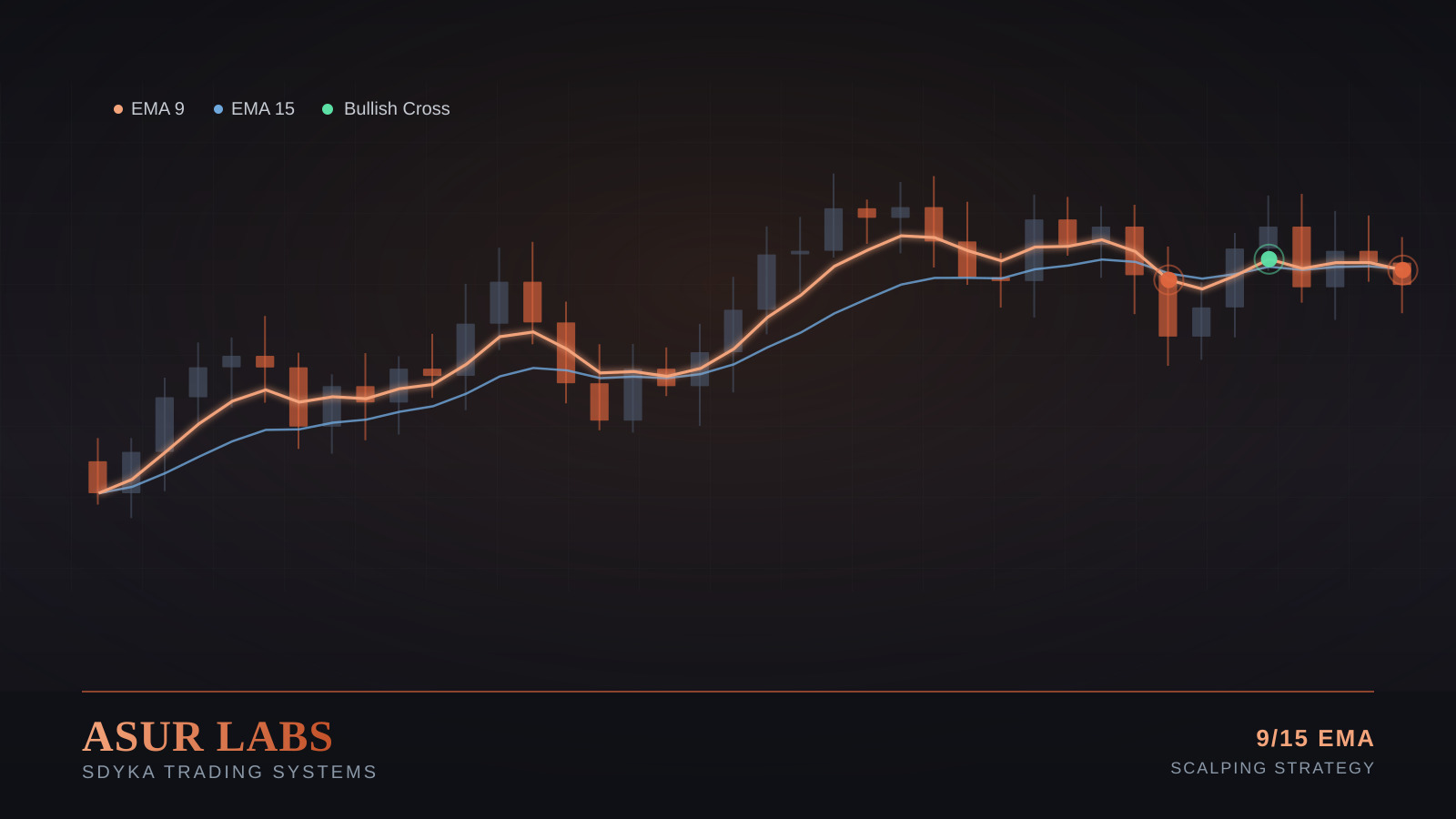
The 9 and 15 period EMA combination is popular among scalpers because it strikes a balance between responsiveness and reliability. The 9 EMA reacts quickly to price, while the 15 EMA smooths out some of the noise. When the faster EMA crosses above the slower one, it signals a potential short-term bullish shift; a cross below signals the opposite.
Used alone, EMA crossovers generate false signals in choppy markets. This is why systems like SDYKA 9/15 EMA Scalping combine the crossover with an ADX filter to confirm trend strength and an HTF bias check, so entries are taken only in the direction supported by the higher timeframe.
Setting Up Your Charts
A clean scalping setup avoids clutter. Start with the 9 and 15 EMA on your entry timeframe, add ADX to gauge trend strength, and keep a higher timeframe chart open alongside it to check bias before every session. Too many indicators competing for attention slows down decision-making — and in scalping, speed and clarity matter more than complexity.
Entry and Exit Rules
Discipline in scalping comes from having rules defined in advance, not decided in the moment.
• Confirm HTF bias first — only take crossovers in the direction of the higher timeframe trend
• Wait for ADX to confirm the market has enough momentum to move, rather than trading flat conditions
• Enter on the candle close after a confirmed crossover, not mid-candle
• Set TP1, TP2, and TP3 in advance, and move stop loss to breakeven once TP1 is hit
• Exit fully if price closes back against the EMA crossover before reaching TP1 — this signals the setup has failed
Risk Management for Scalpers
Because scalping involves a high frequency of trades, risk per trade should be kept small — typically 0.5% to 1% of account equity. A string of losses is inevitable in any strategy, and position sizing is what determines whether that string is a manageable drawdown or an account-ending event.
Common Pitfalls
The most common mistake in EMA scalping is trading every crossover regardless of context. Not every cross is a valid signal — context from HTF bias and trend strength is what separates a high-probability setup from noise. Overtrading during low-volatility sessions and revenge trading after a loss are the two habits that erode accounts fastest, even when the underlying strategy is sound.
The Asur Labs Approach: SDYKA 9/15 EMA Scalping is built exactly on this framework — crossover, ADX confirmation, and HTF bias — so every signal reflects a rule-based process, not a guess.
0 comments
Public reading. Respectful participation is available to eligible signed-in members.
Sign in with an eligible membership to comment. Likes and sharing remain public.
Log in to leave a verified review. Likes and sharing remain public.