
Breakout or Fakeout?
By Paul · Published 22 August 2026 · Updated 22 August 2026 · 5 min read
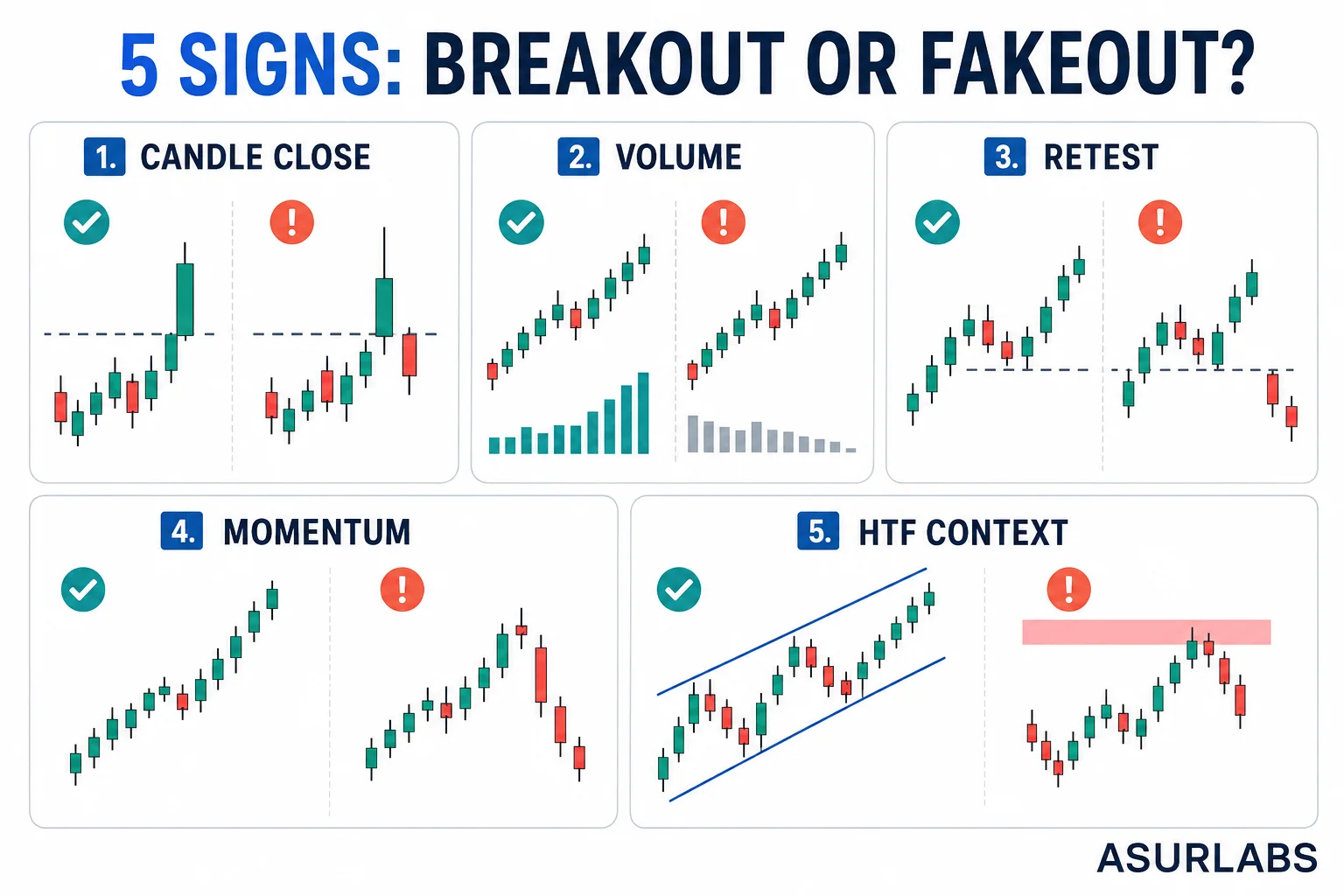
Breakout or Fakeout? 5 Important Signals Every Trader Should Check
Breakout trading can offer excellent opportunities—but not every move beyond support or resistance is a genuine breakout. Sometimes price crosses a key level, attracts traders into the market, and then quickly reverses. This is commonly known as a fakeout or false breakout. Although no method can identify every fakeout with certainty, the following five signals can help traders evaluate whether a breakout has genuine strength or is more likely to fail.
1. Check the Candle Close—not Just the Wick
A candle wick moving beyond support or resistance is not always a confirmed breakout. Price may briefly cross the level because of volatility, liquidity collection, a stop hunt, or temporary market pressure. If the candle closes back inside the previous range, the breakout may be weak or false.
A stronger breakout generally shows:
- A decisive candle-body close beyond the key level
- A reasonably strong candle body
- Limited rejection from the breakout area
- The candle closing near its high in a bullish breakout
- The candle closing near its low in a bearish breakout
Example
If price moves above resistance but closes below it, buyers have failed to maintain control. However, if the candle body closes clearly above resistance, the breakout has stronger initial confirmation.
Key principle: A wick shows that price visited a level; a candle close shows where the market accepted price.
2. Look for Volume Expansion
Volume can provide useful information about the strength behind a breakout. A genuine breakout is often supported by increased market participation. If price crosses an important level while volume remains weak, the move may lack sufficient commitment to continue.
Look for:
- Higher volume compared with recent candles
- Increasing activity as price approaches the level
- Strong participation during the breakout candle
- Continued activity after the breakout
A low-volume breakout does not automatically mean the move will fail. However, weak participation should encourage traders to wait for additional confirmation.
Important Forex Note
In decentralized forex markets, many platforms display tick volume, not total centralized market volume. Tick volume can still be useful for comparing relative activity on the same broker or data feed, but it should not be treated as a complete measurement of global forex volume.
3. Observe the Retest
After breaking a key level, price often returns to test it from the opposite side.
In a bullish breakout:
- Previous resistance may become support.
In a bearish breakout:
- Previous support may become resistance.
A successful retest may include:
- Price returning to the broken level
- Rejection from that level
- A confirmation candle forming in the breakout direction
- Price continuing away from the level
A failed retest may occur when price moves back through the broken level and closes inside the previous range. This can indicate that the breakout was not accepted by the market.
Not every valid breakout produces a perfect retest. Some strong moves continue without returning to the level. Traders should therefore treat a retest as useful confirmation—not a mandatory condition in every market situation.
4. Evaluate Momentum and Follow-Through
A genuine breakout normally needs momentum after crossing the level.
The breakout becomes more convincing when the next candles continue in the same direction instead of immediately reversing.
Positive signs include:
- Strong breakout candle
- Consecutive candles moving in the breakout direction
- Limited overlap between candles
- Higher highs and higher lows after a bullish breakout
- Lower highs and lower lows after a bearish breakout
- No immediate strong rejection candle
Warning signs include:
- A long rejection wick
- A weak or indecisive breakout candle
- Immediate reversal after crossing the level
- Price repeatedly moving above and below the same level
- A strong engulfing candle against the breakout direction
Momentum does not guarantee continuation, but a breakout without follow-through deserves additional caution.
5. Confirm the Higher-Timeframe Context
A breakout should not be analyzed in isolation.
A setup may appear strong on a lower timeframe but move directly into a major higher-timeframe support, resistance, supply, or demand area.
Before entering, check:
- The higher-timeframe trend
- Major support and resistance zones
- Previous swing highs and lows
- Market structure
- Nearby supply or demand areas
- Important session levels
- Scheduled high-impact economic events
For example, an M5 bullish breakout may have limited potential if price is approaching a major H1 or H4 resistance zone.
A breakout aligned with the higher-timeframe structure generally has better contextual support than one moving directly against it.
Quick Breakout Confirmation Checklist
Before considering a breakout trade, ask:
✅ Did the candle body close clearly
beyond the level?
✅ Was there meaningful volume or market
participation?
✅ Did price successfully retest the
broken level?
✅ Is there momentum and follow-through?
✅ Does the higher-timeframe structure
support the move?
✅ Is there enough space before the next
major opposing zone?
✅ Is the potential reward reasonable
compared with the risk?
✅ Is high-impact news likely to create
abnormal volatility?
One signal alone is rarely enough. A stronger setup usually appears when several forms of confirmation align.
Final Thoughts
The objective is not to predict every breakout perfectly. The objective is to avoid reacting to every temporary move beyond a support or resistance level.
Waiting for confirmation may occasionally result in a later entry or a missed trade. However, it can also reduce impulsive entries into weak breakouts.
Always define your entry, stop-loss level, profit target, and acceptable risk before entering a trade. No breakout pattern or confirmation method can eliminate market uncertainty.
Which signal helps you identify fakeouts most effectively—candle close, volume, retest, momentum, or higher-timeframe context? Share your experience in the ASURLABS Forum.
Educational content only. This material does not constitute financial or investment advice. Trading involves substantial risk, and losses may exceed expectations.
#ASURLABS #ForexEducation #BreakoutTrading #Fakeout #PriceAction #TechnicalAnalysis #RiskManagement
0 comments
Public reading. Respectful participation is available to eligible signed-in members.
Sign in with an eligible membership to comment. Likes and sharing remain public.
Log in to leave a verified review. Likes and sharing remain public.